Thursday, 3 August 2017

Friday, 14 July 2017
Brown and White Jack Russels
We have a bad brown and white Jack Russel who is an unwelcome guest.... but which of the several local canines is it? An identity parade and interrogation gave confusing results...


Victorian Style Doll

I produced the design after studying a number of genuine Victorian rag dolls from the collections held by various British museums.
The Victorian dolls were a lot firmer than today's, more of a decoration than a toy, with rods supporting the head and neck, and joints at the knees, elbows, hips and shoulders designed to give a similar range of movement to the corresponding human joints. The fabric was a fine, closely woven linen with seams double stitched... firstly with wrong sides together and secondly with right sides together, enclosing the raw edges of the first seam. Hair and features were embroidered on to the doll after stuffing with sheep's wool and adding limbs.


Friday, 23 June 2017

Thursday, 21 August 2014

Thursday, 24 April 2014
Goat Kids a Day or Two Old.

Above is our first-born goatling, a couple of days old and the apple of his mother's eye.

The twins, born nearly two weeks later, weren't quite so lucky. Here they are just a few hours old. Mum has washed them off, to be fair to her, but now they look clean and tidy she figures that her job has been done, and she can get on with the more serious job of eating. It soon becomes clear that these boys will spend the whole of their childhood chasing their milk supply and snatching it whilst they can.

Monday, 28 October 2013


Monday, 21 October 2013
Kittens Ready to Leave Mum Soon


Five little bundles of fuff ready to leave Mum in a couple of weeks. Two ginger, one black or possibly darkest tabby, and two creamy coloured with Siamese type points. Mum is quarter Siamese, Dad half Siamese. The last photo shows one with parents. The kittens are about 3 weeks old in these photos, and just beginning to look for a way out of their basket and into the wider world!
Wednesday, 11 September 2013
Alresford Show 2013
Spot and Mia, the terrible Lleyn twins that I bottle reared through 2012, are all grown up and "normal" sheep now - or are they? Exhibiting the usual wayward behaviour of cade lambs, they still have no fear of, or respect for, their human slaves.
True to form, Spot enjoyed her day in the limelight and was justly proud of the 4th prize rosette the two shearlings were awarded in the PAIRS class. Mia, however, has a stubborn streak... Mia will do exactly what Mia wants to do - or else go into spoiled child syndrome and throw a massive sulk

So the moment I opened the pen gate to lead the two into the arena, that behaviour shone forth. Spot leapt forward towards the party with total enthusiasm and a fair turn of speed. Mia declined the invitation. With Spot on the end of her lead and through the second gate into the arena, Mia threw herself onto the ground in her pen gateway.. With a pocket full of food, I coaxed, pleaded, pushed, pulled and lifted. But when I hauled the back end up, the front end slumped on the ground. When I pulled the head up, the back end collapsed... And hungry she was not! It was Spot's incessant bleatings of complaint and usual impatience that finally allowed her to permit being half dragged and half carried into the line-up, where she buried her head between her knees. But luck was with us - we were not asked to move again until Spot's sweetest smile had influenced the judge, and leaving the ring was far easier than entering it...

True to form, Spot enjoyed her day in the limelight and was justly proud of the 4th prize rosette the two shearlings were awarded in the PAIRS class. Mia, however, has a stubborn streak... Mia will do exactly what Mia wants to do - or else go into spoiled child syndrome and throw a massive sulk

So the moment I opened the pen gate to lead the two into the arena, that behaviour shone forth. Spot leapt forward towards the party with total enthusiasm and a fair turn of speed. Mia declined the invitation. With Spot on the end of her lead and through the second gate into the arena, Mia threw herself onto the ground in her pen gateway.. With a pocket full of food, I coaxed, pleaded, pushed, pulled and lifted. But when I hauled the back end up, the front end slumped on the ground. When I pulled the head up, the back end collapsed... And hungry she was not! It was Spot's incessant bleatings of complaint and usual impatience that finally allowed her to permit being half dragged and half carried into the line-up, where she buried her head between her knees. But luck was with us - we were not asked to move again until Spot's sweetest smile had influenced the judge, and leaving the ring was far easier than entering it...

That left the rest of the day to be enjoyed. So Spot played up to her admiring public and rushed back into the ring for the "Meet the Sheep" event, whilst Mia preferred to keep her nose firmly planted on the ground... But was she pleased to go? Of course not! Obviously warming to the whole idea of a party, she dug her heels in once more, being the last of our little group to be dragged back into the trailer.
Thursday, 22 August 2013
Rheas Home, Safe and Well!
Many, many thanks to all those who helped recapture, were unwilling
landlords, or scoured the countryside looking for our two boys! After 21
days and over 150 hours of searching, the two were both tempted back
home through their stomachs (typical males!).
I can't say what a relief it is to no longer be waking up in the morning to face another probably fruitless day of searching - and my chances of finding and bringing them home without the help of so many friends, family and total strangers would have been very slim indeed!
Incidentally, these birds have been kept behind stock fence without problems all of their lives, and the two escapees were over 6. Like most horses, they are happy where they live and respect the fences. But fear raises adrenalin levels, and adrenalin gives that extra energy and courage to push a creature higher and faster - that is what it's for! At the end of the day, rhea are birds. They might not be able to fly, but they have a pretty good bounce! By pushing off of lower bars they can effectively climb, and vault over the top of a fence or gate using their strong neck muscles to help them sideways over the top, and their large wings to give them lift and balance. My guess would be that they could clear 6ft if adrenalin was high enough, in a "run or die" situation. If they failed, then they might very well die of heart attack or injuries incurred, whilst repeatedly trying.
Adult rhea are also capable of delivering a very effective peck or a fatal kick to a dog (or fox), and will do so in self defence. Fortunately for this dog, our birds are not used to having to protect themselves against domestic animals and caught unawares, their first instinct was to run.
I can't say what a relief it is to no longer be waking up in the morning to face another probably fruitless day of searching - and my chances of finding and bringing them home without the help of so many friends, family and total strangers would have been very slim indeed!
Incidentally, these birds have been kept behind stock fence without problems all of their lives, and the two escapees were over 6. Like most horses, they are happy where they live and respect the fences. But fear raises adrenalin levels, and adrenalin gives that extra energy and courage to push a creature higher and faster - that is what it's for! At the end of the day, rhea are birds. They might not be able to fly, but they have a pretty good bounce! By pushing off of lower bars they can effectively climb, and vault over the top of a fence or gate using their strong neck muscles to help them sideways over the top, and their large wings to give them lift and balance. My guess would be that they could clear 6ft if adrenalin was high enough, in a "run or die" situation. If they failed, then they might very well die of heart attack or injuries incurred, whilst repeatedly trying.
Adult rhea are also capable of delivering a very effective peck or a fatal kick to a dog (or fox), and will do so in self defence. Fortunately for this dog, our birds are not used to having to protect themselves against domestic animals and caught unawares, their first instinct was to run.
Wednesday, 31 July 2013
Rhea Missing After Dog Attack

I have injured and missing rhea after an attack by two dogs
Centre back:
April, last year’s first born. Like the rest of last year’s chicks, she grew up
believing my German Shepherd was her mother and something to cuddle up to.

Right:
Tommy, leader of the younger group, was found in a garden and recaptured,
traumatized but unharmed. Like April, he had lost any inherit fear of dogs.
Left: Boomer
– 5 yrs old, 5 foot high, is the noisy one and Top of the Flock. We know he is
in a field near Binley but he needs to calm down before I can coax him back
home.
Centre: DC –
Daddy Day Care – 5 yrs old and so named because he has always assumed the
daytime duties of caring for chicks and youngsters. DC is still missing, believed injured. Rhea are hard to catch,
especially when hurt or frightened – and are best coaxed by a known handler
rather than coerced. They hide in long grass (undoubtedly what he’s doing now!),
run up to 40 mph and can kick hard in self defence if trapped or cornered.
Please, please, contact Elaine Frogley,
07826 464910 if you see him. All information gratefully received –
this beautiful bird is scared and hurt somewhere!
Wednesday, 24 July 2013
ODD FRIENDS?
In their native countries, wild rhea will often follow a herd of cattle. Their quick reactions help themselves as well as the cattle as they catch the flies that are attracted too, and annoy, the cattle.
At Rope Yarn Corner there are no cattle, so the rhea make do with ponies. It was not love at first sight. The ponies were petrified by these goose-like creatures who could instantly fluff up their feathers and double their size. Nor were they impressed to discover that these oversize chicken could run somewhat faster than they could. In fact, for a while at least, the arrival of the rhea meant that the ponies actually stayed behind their electric fence, even though the current wasn't turned on!
For their part, the rhea disliked the fact that ponies will insist on poking their noses into places where noses have no business to be. This problem, however, was quickly cured by the discovery that ponies noses react favourably to a quick, well-aimed peck. And nothing has a quicker, better aimed peck than a rhea. This is also why the birds don't mind sharing their food with the ponies, they can pick up 100 grains of corn or pellets from the grass in the time it takes a pony's clumsy, snuffling muzzle to retrieve just one...


It's enough to give a horse a complex when he meets a bird bigger than himself...

Monday, 3 June 2013
Sunday, 2 June 2013
Chick's position in egg
This turkey poult pipped earlier than expected, and was still in a forced air incubator at the time. This meant that humidity was too low for hatching, and added to that, the forced air system quickly dried the membranes onto its down, making it impossible for it to move. Whilst I don't usually help chicks to hatch (they are usually too weak to survive long, or malformed), I did on this occasiion as the bird had good reason for being unable to break out unaided, so I soaked the membrane in warm water and removed it. The grateful bird was kind enough to remain in its final position long enough for me to take a photo, giving a good view of a typical chick immediately prior to hatching. As hoped, it made a full recovery, with the only apparent problem being short-term exhaustion caused by its futile attempts to escape from the dry egg.


Tuesday, 28 May 2013
Rhea
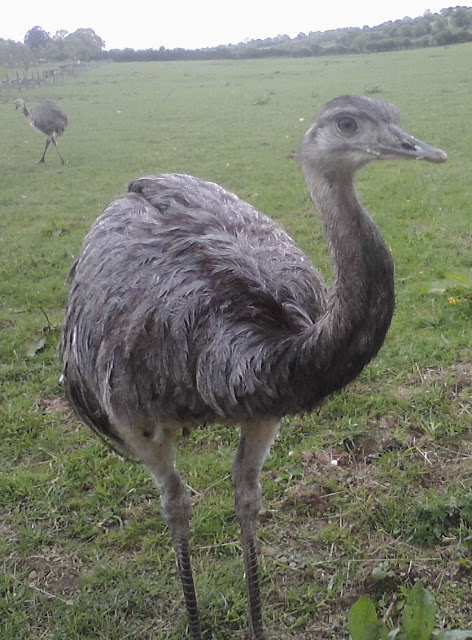
Our three young rhea had their first taste of relative freedom in the main field today. They are approaching one year old, and about 2/3 of their final weight and size.

Tuesday, 21 May 2013
Adders and Grass Snakes
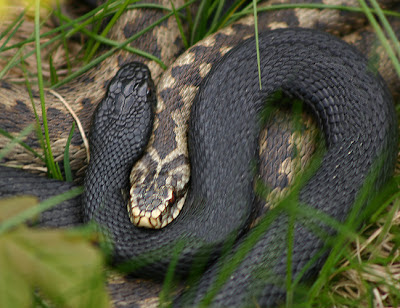
The Common European Adder, vipera berus is alive and well in our area. One was spotted crossing the road last week, during one of those rare hours of sunshine. In UK these snakes are protected by the 1981 Wildlife and Countryside Act, which basically makes it illegal to kill, harm in any way, or sell them. Missed the photo opportunity on my doorstep, but here is one from the common archives showing the normal diamond pattern and the less common melanistic colour. Generally the male is lighter in colour, and the female brownish with darker diamonds.
The adder is our only venomous snake, with its bite being painful but rarely fatal. It is not an aggressive creature, only biting if alarmed, cornered or hurt. In short - don't interfere, and the snake will leave you be!
Adders eat small mammals, frogs, occasionally (very low flying!) birds, nestlings on the ground or low in hedges, and eggs. If they come after my eggs they will have to take their place in the queue though, behind the rooks and the badger!

The adder is our only venomous snake, with its bite being painful but rarely fatal. It is not an aggressive creature, only biting if alarmed, cornered or hurt. In short - don't interfere, and the snake will leave you be!
Adders eat small mammals, frogs, occasionally (very low flying!) birds, nestlings on the ground or low in hedges, and eggs. If they come after my eggs they will have to take their place in the queue though, behind the rooks and the badger!

Also very close to Rope Yarn Grass Snakes, Natrix natrix, are beginning to become active. As their name implies (Natrix from Latin Natare, "to swim") they are usually found near water, and are not slow to clear grden ponds of frogs or fish! Again, they are protected by the Wildlife and Countryside Act in UK. Thanks to Wikimedia Commons fro use of these photo's.

Southern England is also the most Northern home of the Smooth Snake, Coronella austriaca. I've never seen one - but it would be greta to hear from anyone who has spotted onein recent years!
Friday, 12 April 2013
Spinning Lambs

Well there's wool on it and it smells like Mum... maybe we need to turn that wheel to get the milk out?"

Thursday, 11 April 2013
Turkeys on Parade
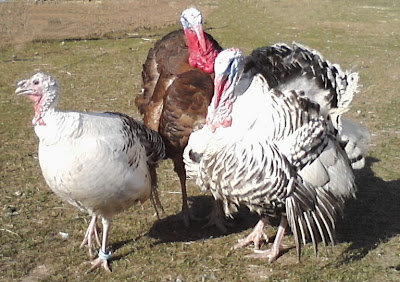
My older turkeys - Crollwitzer and Bourbon Red - are beginning to display themselves and "strutt their stuff" for the attention of their girls. The unusually cold weather has meant that all the birds are coming into lay late, although I did get half a dozen eggs from the Crollwitzer girls last week - until this weeks cold snatch stopped them in their tracks!


Subscribe to:
Posts (Atom)